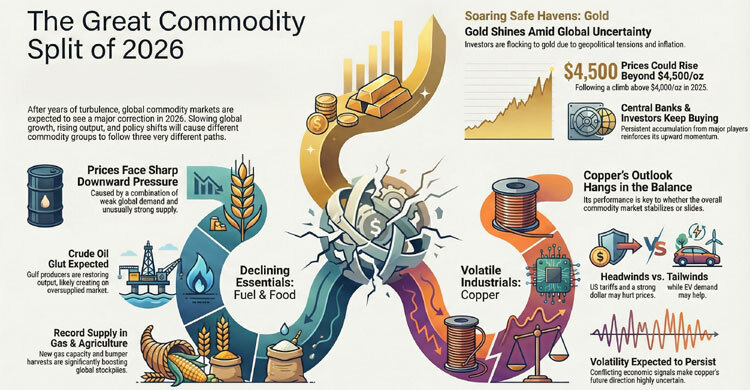
The term “commodities slump” refers to a broad and sustained decline in the prices of raw materials such as oil, metals, agricultural products, and energy resources. Over the past few years, global commodity markets have faced significant downward pressure, driven by a complex mix of economic, geopolitical, and structural factors. Slowing global growth has reduced demand for industrial inputs, while improvements in production efficiency and supply chain expansion have increased supply in several sectors. Together, these forces have created an imbalance that continues to weigh heavily on prices, affecting producers, exporters, and even consumers across the world.
Key Economic and Global Drivers
One of the most important drivers behind the commodities slump is the slowdown in major economies, particularly China, which has long been the largest consumer of industrial commodities such as iron ore, copper, and coal. As China’s growth model has shifted from heavy industry toward services and domestic consumption, its appetite for raw materials has weakened. At the same time, tightening monetary policies in developed economies, especially higher interest rates, have strengthened the US dollar. Since most commodities are priced in dollars, a stronger dollar makes them more expensive for buyers using other currencies, further suppressing demand and contributing to falling prices.
Supply Gluts and Overproduction
Another major factor behind the commodities slump is persistent overproduction. During previous commodity booms, high prices encouraged producers to invest heavily in new mines, oil fields, and agricultural capacity. These projects often take years to come online, and when they do, they can flood the market even if demand has cooled. This has been especially visible in the energy sector, where technological advances such as shale extraction have dramatically increased oil and gas output. The result has been chronic oversupply, forcing prices lower as producers compete to maintain market share.
Impact on Commodity-Exporting Economies
The consequences of a commodities slump are particularly severe for countries that rely heavily on raw material exports. Nations in Africa, Latin America, and the Middle East often depend on commodities for government revenue, foreign exchange earnings, and employment. Falling prices can lead to budget deficits, currency depreciation, and reduced public spending on infrastructure, health, and education. In some cases, prolonged slumps have triggered social unrest and political instability, highlighting how closely commodity markets are tied to broader economic and social outcomes.
Effects on Businesses and Consumers
While a commodities slump can be damaging for producers, it can also bring mixed effects for businesses and consumers. Lower input costs can benefit manufacturers by reducing production expenses, potentially boosting profit margins if savings are passed through the supply chain. Consumers may also enjoy lower prices for fuel, food, and energy, increasing disposable income. However, these benefits are often uneven and may be offset by job losses and reduced investment in commodity-dependent regions, which can weaken overall economic confidence.
Long-Term Outlook and Structural Shifts
Looking ahead, the future of commodity markets will depend on how global economies adapt to structural changes such as the energy transition, technological innovation, and climate policies. The push toward renewable energy and decarbonization may reduce long-term demand for fossil fuels while increasing demand for certain metals like lithium, cobalt, and copper. This suggests that while traditional commodities may continue to face pressure, new opportunities could emerge within specific segments of the market. The curren commodities slumpt commodities slump may therefore represent not just a cyclical downturn, but a turning point toward a more selective and transformation-driven commodity landscape.
Conclusion
In summary, the commodities slump is the result of intertwined economic slowdowns, currency dynamics, and long-term supply expansions that have reshaped global markets. Its impacts are far-reaching, influencing national economies, corporate strategies, and household budgets. Understanding the causes and consequences of this downturn is essential for policymakers, investors, and businesses seeking to navigate uncertainty. While challenges remain, the evolving nature of global demand also offers the potential for recovery and reinvention within the commodity sector.
Leave a Reply